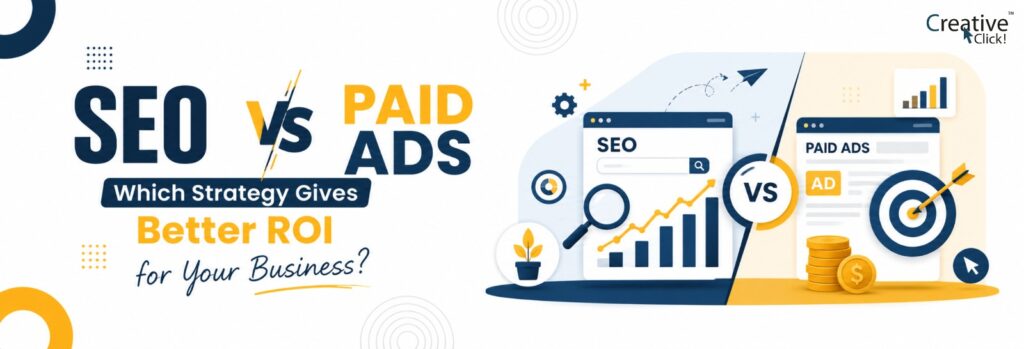
In today’s digital-first business environment, companies are investing more in online marketing than ever before. Whether you own a startup, a local service business, an e-commerce brand, or a large enterprise, your online visibility directly influences your ability to attract customers and generate revenue. However, with multiple marketing channels available, businesses often face a critical question: seo agency in indorevs Meta ads agency in Indore, which strategy delivers the highest return on investment?
The answer is not as simple as choosing one over the other. Both Search Engine Optimisation (SEO) and paid advertising have proven their effectiveness in helping businesses reach potential customers. However, they work in fundamentally different ways and offer different advantages depending on business goals, industry competition, budget and growth timeline.
Some businesses prioritise immediate results and rapid lead generation, while others focus on long-term visibility and sustainable traffic growth. Understanding how both strategies contribute to digital marketing ROI can help business owners make informed decisions and allocate their marketing budgets more effectively.
In this blog, we’ll explore the differences between SEO and paid advertising, examine their strengths and limitations and determine which approach offers the best return for modern businesses.
Understanding SEO and Its Long-Term Value
Search Engine Optimisation is the process of improving a website’s visibility in search engine results without paying directly for clicks. The goal is to improve organic search ranking so that when users search for relevant products, services, or information, the website appears prominently in search results. Google documents the fundamentals in its SEO Starter Guide.
SEO involves multiple components, including keyword research, content creation, technical optimisation, website speed improvements, mobile responsiveness, user experience enhancements, local SEO and authority building through backlinks.
Unlike paid advertising, SEO focuses on earning visibility rather than purchasing it. This means businesses invest in building a strong digital foundation that attracts visitors naturally over time.
One of the biggest advantages of SEO is sustainability. Once a website achieves strong rankings for valuable keywords, it can continue generating traffic consistently without ongoing advertising costs for every visitor. This makes SEO one of the most cost-effective long-term marketing strategies available.
However, SEO requires patience and consistency. Results often take several months to appear, particularly in competitive industries. Businesses that view SEO as a long-term investment tend to experience the greatest success because they focus on building authority and trust rather than seeking immediate returns.
Why Organic Search Ranking Matters More Than Ever
Modern consumers trust search engines when researching products, services and solutions. When a website appears at the top of organic search results, it often gains a level of credibility that advertisements may not immediately provide.
A strong seo company in indore offers several advantages. First, it increases visibility among users actively searching for relevant information. These users often have high purchase intent, making them valuable prospects for businesses.
Second, organic rankings help build brand authority. Consumers frequently associate top-ranking websites with expertise and reliability. This perception can influence purchasing decisions and improve conversion rates.
Third, organic traffic is sustainable. Unlike paid advertising campaigns that stop generating traffic when budgets are paused, SEO continues delivering results long after the initial optimisation efforts.
As competition increases across digital channels, businesses that invest in SEO are creating valuable digital assets that contribute to long-term growth and profitability.
Understanding Paid Advertising and Its Immediate Impact
Paid advertising allows businesses to purchase visibility on search engines, social media platforms and other digital channels. Through a strategic Google Ads strategy, companies can appear at the top of search results almost instantly. Campaign types are explained in Google Ads Help.
This immediate visibility is one of the primary reasons businesses invest in paid advertising. Instead of waiting months for SEO improvements, businesses can begin attracting traffic, generating leads and driving sales within hours of launching a campaign.
Paid advertising offers precise targeting capabilities. Businesses can target users based on location, demographics, interests, search behaviour, purchasing intent, device type and numerous other criteria. This level of precision helps maximise advertising effectiveness and improve campaign performance.
The popularity of Google ppc agency in Indore has grown significantly because businesses increasingly recognise the value of reaching potential customers at the exact moment they are searching for products or services.
For businesses seeking rapid growth, product launches, seasonal promotions, or immediate lead generation, paid advertising can be a powerful solution.
Comparing SEO vs Paid Ads: Speed of Results
One of the biggest differences between SEO vs paid ads is the speed at which results are generated.
Paid advertising delivers immediate visibility. A business can launch a campaign today and begin receiving traffic, inquiries and sales almost immediately. This makes paid advertising highly attractive for companies that need quick results or are operating within specific promotional timelines.
SEO, by contrast, requires time to build authority and improve rankings. Search engines evaluate numerous factors before rewarding websites with top positions. As a result, SEO campaigns often take three to six months or longer in highly competitive industries to produce significant results.
While this slower timeline can be frustrating for some businesses, the long-term benefits often outweigh the initial waiting period. Once strong rankings are established, SEO continues generating traffic without requiring payment for every click.
Businesses should evaluate their immediate needs and long-term objectives when deciding how to balance these two strategies.
Evaluating Digital Marketing ROI
Every marketing investment should ultimately be measured by its ability to generate returns. This is where the discussion around best digital marketing agency in Indore becomes especially important.
Paid advertising often delivers faster returns because campaigns can generate leads and sales immediately. Businesses can track conversions, calculate customer acquisition costs and optimise campaigns based on performance data.
However, paid advertising requires continuous spending. When advertising budgets stop, traffic and lead generation typically stop as well.
SEO operates differently. Although it may take longer to generate results, the long-term cost per acquisition often decreases significantly as organic rankings improve. Businesses continue benefiting from traffic without paying for each visitor individually.
Over time, SEO often produces stronger ROI because the value of accumulated rankings, content and authority continues growing while ongoing costs remain relatively stable.
The most successful businesses understand that ROI should be evaluated over both short-term and long-term periods rather than focusing solely on immediate returns.
The Importance of a Strong Google Ads Strategy
A successful google ads services in indore is about much more than simply bidding on keywords. Effective campaigns require audience research, keyword analysis, ad creation, landing page optimisation, conversion tracking and ongoing performance management.
Google Ads allows businesses to target high-intent users who are actively searching for solutions. This often results in strong lead quality and higher conversion rates compared to broader advertising channels.
Modern advertising platforms also leverage artificial intelligence and machine learning to optimise bidding, audience targeting and campaign performance. Businesses can use these technologies to maximise efficiency and improve results.
When managed correctly, Google Ads can become a highly profitable customer acquisition channel that complements broader digital marketing efforts.
Why PPC Campaigns in India Continue to Grow
The growth of digital commerce and online services has increased demand for PPC campaigns in India across virtually every industry. Businesses are competing for visibility in increasingly crowded markets, making paid advertising an essential component of many marketing strategies.
PPC campaigns offer flexibility, scalability and measurable results. Businesses can start with modest budgets and increase spending as campaigns prove successful.
Additionally, paid advertising provides valuable data that can inform broader marketing decisions. Businesses can identify high-performing keywords, understand customer behaviour and refine messaging based on campaign insights.
This ability to generate immediate traffic and actionable data makes PPC a valuable tool for businesses seeking growth.
Online Advertising Tips for Maximising Results
Successful digital marketing requires strategic execution. Some of the most effective online advertising tips include focusing on audience intent, creating compelling landing pages, testing multiple ad variations, monitoring performance metrics and continuously optimising campaigns.
Businesses should also ensure that their websites provide excellent user experiences. Even the most effective advertisements will struggle to generate conversions if users encounter slow-loading pages, confusing navigation, or weak calls to action. Local listings should also be kept current via Google Business Profile.
Consistency is equally important. Marketing success rarely comes from a single campaign. Long-term growth requires ongoing optimisation, experimentation and adaptation.
Why the Best Approach Is Often a Combination of Both
Many businesses mistakenly view SEO and paid advertising as competing strategies. In reality, they are most effective when used together.
SEO builds authority, trust and long-term visibility. Paid advertising generates immediate traffic and supports short-term objectives. Together, they create a balanced marketing ecosystem that delivers both immediate and sustainable results.
For example, businesses can use paid advertising to generate leads while simultaneously investing in SEO to build future organic visibility. As rankings improve, dependence on paid advertising may decrease while lead generation remains strong.
This integrated approach often produces the strongest Lead generation agency in Indore because it leverages the strengths of both channels.
How Creative Click Helps Businesses Build Sustainable Growth
Navigating modern digital marketing requires expertise, strategic planning and continuous optimisation. As the best digital marketing agency, Creative Click helps businesses develop customised strategies that combine the power of SEO and paid advertising.
Rather than promoting one approach over the other, Creative Click evaluates each client’s goals, industry, audience and competition to create balanced marketing solutions. Whether the objective is improving organic search ranking, implementing a high-performing Google Ads strategy, or maximising digital marketing ROI, the agency focuses on delivering measurable results.
By combining data-driven insights, creative execution and performance-focused optimisation, Creative Click helps businesses strengthen their online presence and achieve long-term growth.
Many businesses discover that the most effective strategy is not choosing SEO or paid advertising but using both intelligently as part of a comprehensive digital marketing plan.
Conclusion
The debate surrounding SEO vs paid ads is not about determining a single winner. Both strategies offer unique advantages and can contribute significantly to business success.
SEO provides long-term value through improved organic search ranking, sustainable traffic and lower long-term acquisition costs. Paid advertising, supported by a well-executed Google Ads strategy, delivers immediate visibility, rapid lead generation and measurable results.
When evaluating digital marketing ROI, businesses should consider both immediate performance and long-term growth potential. While paid advertising offers speed, SEO builds lasting authority. Together, they create a powerful combination capable of driving consistent business growth.
Whether you’re investing in SEO, launching PPC campaigns in India, implementing new online advertising tips, or partnering with the digital marketing agency in Indore, the key to success lies in strategic planning, continuous optimisation and a clear understanding of your audience.
Businesses that embrace both organic and paid marketing channels are often the ones that achieve sustainable visibility, stronger customer acquisition and long-term competitive advantage in the digital marketplace.