
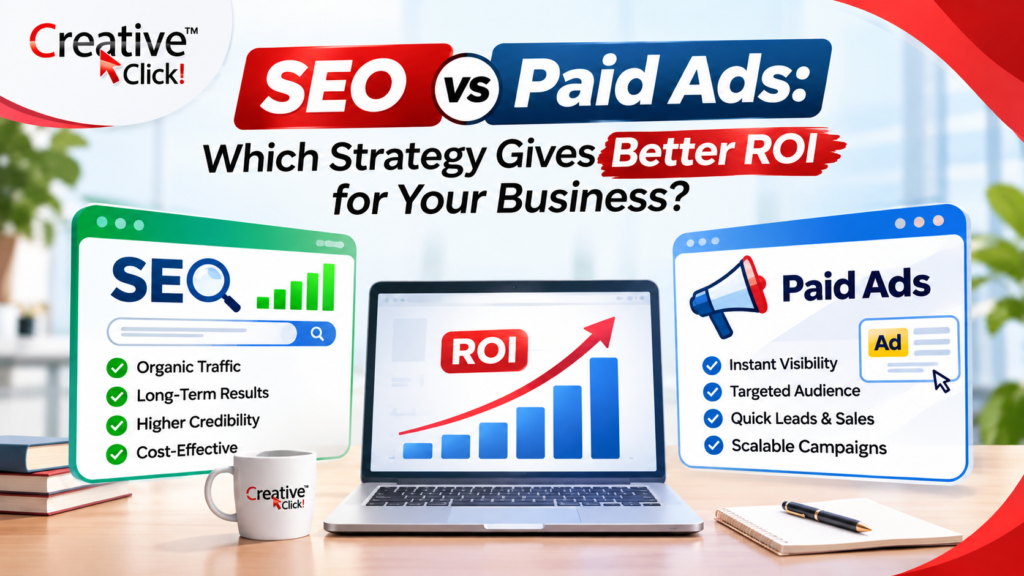
You have a marketing budget and two very different ways to spend it. Put it into search engine optimization (SEO) and you may wait a few months before the phone starts ringing. Put it into paid ads and leads can arrive this week, but they can stop just as quickly when the budget runs out.
So which one really gives better ROI? The honest answer to the SEO vs paid ads question is: it depends on your cash flow, your sales cycle, your competition and how soon you need results. This guide helps you compare the two with simple arithmetic instead of opinions. You will see where each one wins, what a realistic break-even timeline looks like, and why most growing businesses end up using both.
Key takeaways
- Paid ads give speed and control. SEO is slower to start, but when it works it can bring a lower cost per customer over time.
- Paid ROI starts early but stops the day spending stops. SEO ROI starts later but keeps working.
- Compare channels on cost per lead, cost per customer and profit over 12 to 24 months, not on clicks or rankings.
- No one can honestly promise a number one ranking, so be careful with anyone who does.
- For most businesses a hybrid plan works best: ads for quick wins, SEO for the long run.
What are SEO and paid ads?
SEO is the work of making your website easy for Google to understand and worth showing in the organic (unpaid) results. That includes technical fixes, useful content, local signals and trust. You do not pay Google per click. Google’s own SEO Starter Guide is a good free place to learn the basics.
Paid ads are placements you pay for. On Google Ads you usually pay each time someone clicks (PPC). On Facebook and Instagram you pay for reach or clicks. The ads appear only while your budget is running.
Both can bring buyers to your website, but they behave very differently. We run both for clients, from SEO services to Google PPC management and Meta ads.
How each channel makes (and loses) money
Think of paid ads as renting a shop on a busy street. The moment you pay, customers can walk in. The moment you stop paying, the shop is closed. Your cost per click is set by an auction, so more competition usually means higher prices. Google describes Quality Score as a diagnostic that shows how your ads and landing pages compare with others, which is a useful reminder that better ads and pages can reduce what you pay.
SEO is closer to buying the property. The upfront effort is heavier: an audit, technical fixes, content, local listings and links. But once a page ranks, it can bring visitors month after month without a per-click charge. You still need to maintain it, because competitors and Google keep changing, but the cost per visitor usually falls as the asset grows.
How to calculate ROI for SEO vs paid ads
The basic formula is the same for both:
ROI % = (Revenue from the channel − Cost of the channel) ÷ Cost of the channel × 100
To keep it honest, also track cost per lead, cost per customer and the value of a customer over time.
Here is a simple example. These numbers are made up for illustration. They are not typical results or a promise, and the SEO ramp-up and year 2 figures are assumptions that may not hold for your business. Assume a service business with an average sale of ₹10,000, a website that converts 3% of visitors into leads, and one in five leads becoming a customer.
Paid ads: ₹50,000 a month at about ₹25 per click gives roughly 2,000 clicks, 60 leads and 12 customers, which is ₹1,20,000 in revenue every month from the first month.
SEO: ₹30,000 a month. There is little revenue in the first three months, then it grows as pages start ranking and earning clicks.
| Metric | Paid ads | SEO |
|---|---|---|
| Monthly spend | ₹50,000 | ₹30,000 |
| Revenue, months 1 to 3 | ₹1,20,000 per month | ₹0 |
| Revenue, months 4 to 6 | ₹1,20,000 per month | ₹30,000 per month |
| Revenue, months 7 to 9 | ₹1,20,000 per month | ₹60,000 per month |
| Revenue, months 10 to 12 | ₹1,20,000 per month | ₹90,000 per month |
| Year 1 spend / revenue | ₹6,00,000 / ₹14,40,000 | ₹3,60,000 / ₹5,40,000 |
| Year 1 ROI | 140% | 50% |
| Year 2 revenue (assumed) | ₹14,40,000 | ₹14,40,000 (₹1,20,000 per month) |
| 2-year spend / revenue | ₹12,00,000 / ₹28,80,000 | ₹7,20,000 / ₹19,80,000 |
| 2-year ROI | 140% | 175% |
| Cost per customer | About ₹4,167 | About ₹6,667 in year 1, about ₹2,500 in year 2 |
What does this tell us?
- Paid ads win the first year. They produce leads immediately, and in this example they are profitable from month one.
- SEO catches up. In this example its running total breaks even around month 9, and from year 2 it delivers customers at a much lower cost.
- ROI percentage is not the whole story. Paid ads still produce more total profit over two years here (₹16,80,000 against ₹12,60,000) because they involve more spending and more volume.
- Real life is messier. The example assumes paid costs stay flat and SEO keeps growing. In practice paid costs often rise as competitors bid more, and SEO can plateau, take longer or deliver less depending on your market, site and content. Replace our numbers with your own before deciding.
When paid ads are the better choice
- You need leads this month, for a launch, an event, a sale or a festival season.
- Your website is new and has no search visibility yet.
- You want to test offers, messages and keywords quickly before investing in content.
- Your margins are high enough to absorb the cost per click.
- Your product is something people do not search for yet, so you need to put it in front of them on Instagram or Facebook.
When SEO is the better choice
- You can wait a few months for results and want a lower cost per customer afterwards.
- People already search for the problem you solve (“CA near me”, “dentist in Indore”, “wedding photographer”).
- Clicks are very expensive in your industry, which makes paid traffic hard to sustain.
- Visibility in organic results and on Google Maps matters for your business, and some searchers skip results labelled as ads (this varies by industry and audience). If you serve a local area and you do not appear on the map, see our guide on why a business is not showing on Google Maps.
SEO vs paid ads at a glance
| Factor | SEO | Paid ads |
|---|---|---|
| Speed | Months | Days |
| Cost behaviour | Higher upfront effort, lower cost per visit over time | Pay for every click or impression |
| If you stop | Rankings may hold for a while, then slip | Traffic stops immediately |
| Control over targeting | Moderate | High |
| Trust | Can be higher, varies by audience | Ads are labelled, results vary |
| Best for | Long-term growth, local search, content | Launches, offers, testing, fast leads |
| Main risk | Slow start, algorithm changes | Rising costs, wasted spend without tracking |
Why the best answer is often “both”
Most businesses do not need to pick a side. A practical hybrid plan looks like this:
- Start paid on high-intent keywords. This gives you leads and, just as importantly, data about which searches turn into customers.
- Turn the winners into SEO pages. Use your search-terms and conversion reports to decide which topics deserve proper pages, guides and local content.
- Retarget visitors. Show Meta or Google ads to people who already visited your site but did not enquire.
- Measure everything. Track calls, form fills and WhatsApp enquiries so you know which channel earns its budget.
- Review every quarter. As organic traffic grows, you can rebalance spend rather than guess.
How long does SEO really take, and what can anyone promise?
Google’s own starter guide includes a section on how long it can take to see an impact in search results, which is a polite way of saying it is not instant. We have laid out a realistic timeline in our article on how long SEO takes to show results.
Be careful with anyone who guarantees rankings. Google’s guidance on hiring an SEO states that no one can guarantee a number one ranking. A trustworthy partner can promise a clear process, honest reporting and ethical methods, but not control of Google’s results.
Common mistakes to avoid
- Judging SEO after one month. It needs time, so set expectations at the start.
- Running ads without conversion tracking. If you cannot see which clicks became customers, you cannot calculate ROI.
- Sending ad traffic to a weak page. A slow or confusing landing page wastes budget.
- Chasing rankings instead of revenue. A top position for a keyword nobody buys with is worth little.
- Stopping SEO or ads too early. Both need a fair test period and regular improvements.
- Comparing only cost per click. The real measure is cost per customer and profit.
Frequently asked questions
Is SEO better than Google Ads?
Neither is better in every situation. SEO usually becomes cheaper per customer over the long run, while Google Ads is faster and easier to control. The right choice depends on your budget, timeline and market.
Is SEO cheaper than paid ads?
Per customer, SEO is often cheaper in the long run because you are not paying for every click. In the early months, though, you are paying for work before you see returns, so it is not always cheaper on day one.
How long before SEO beats paid ads on ROI?
It depends on your competition and starting point. In our illustrative example, SEO reaches cumulative break-even around month 9 and overtakes paid ads on ROI percentage during year 2. Your numbers will differ, so track your own data.
Which is better for a small business with a limited budget?
If you serve a local area and people already search for your service, start with local SEO and a Google Business Profile, then add a small, tightly tracked ad budget for quick leads. If you need sales immediately, begin with paid ads and build SEO alongside.
Can I do both at the same time?
Yes, and for most businesses it is the best approach. Paid ads give you speed and data, while SEO builds a lasting source of traffic.
How do I calculate SEO ROI?
Use (revenue from organic search − SEO cost) ÷ SEO cost × 100. Track organic leads and customers separately in your analytics so the revenue figure is accurate.
The bottom line on SEO vs paid ads
If you need customers now, paid ads are the faster tool. If you want a lower cost per customer and a business that does not vanish from Google when the budget stops, SEO is the stronger long-term investment. The smartest plan for most businesses is to use ads to learn and earn in the short term while SEO builds the foundation.
Talk to CreativeClick
Not sure how to split your budget? Share your goals, your current website and your monthly budget with the CreativeClick team and we will suggest a practical mix of SEO and paid ads, with the numbers behind it. Call (+91) 98273 84007 or visit our Indore office at 121 B, Nemi Nagar, Jain Colony, Indore.