
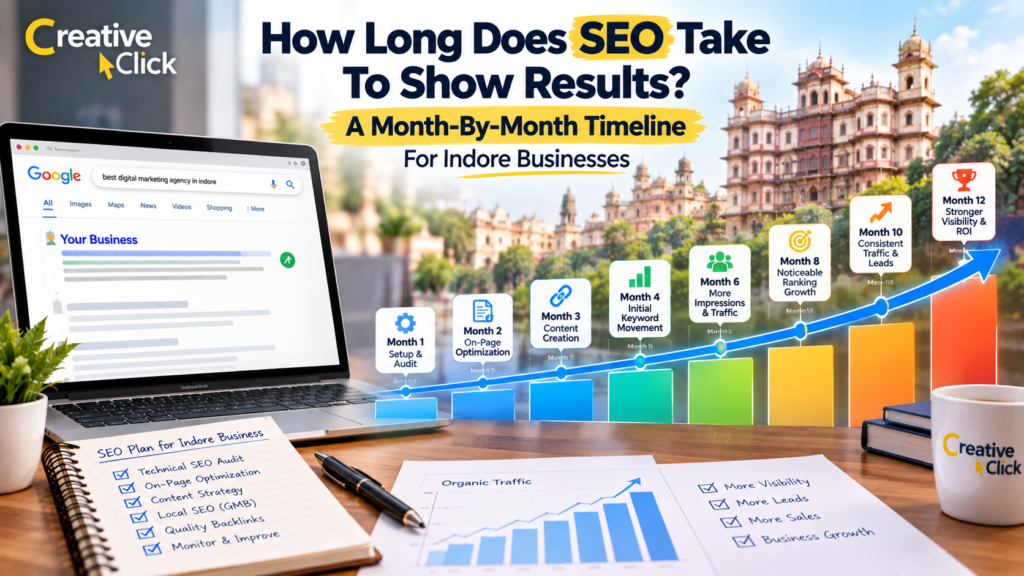
One of the first questions business owners ask before investing in search engine optimization is: how long does SEO take to show results? If you run a business in Indore, you may want to know when your website will start appearing on Google, attracting visitors and generating enquiries. The answer depends on your website’s current condition, competition, content quality and consistency of optimization. Some improvements may become visible within weeks, while meaningful organic growth often requires several months.
Unlike paid advertising, SEO focuses on building sustainable visibility through technical improvements, useful content and website credibility. At Creative Click, we believe businesses should evaluate SEO through realistic milestones rather than expecting instant rankings.
How Long Does SEO Take To Show Results In Google Search?
SEO does not follow a fixed schedule. Google explains that changes can take anywhere from hours to several months to appear in search results. No agency can guarantee a particular ranking or exact timeline.
For planning purposes, early progress may appear within three to six months, while competitive keywords may take six to twelve months or longer. These are estimates rather than guarantees.
The timeline depends on several factors:
- Website history: Established websites may have a different starting point from new domains.
- Competition: Highly competitive keywords usually require more effort.
- Technical health: Indexing issues and broken links can restrict visibility.
- Content quality: Helpful pages give search engines relevant information about your business.
- Consistency: Regular improvements support long-term progress.
Month 1: SEO Audit And Strategy Development
The first month focuses on understanding your website and identifying the most important opportunities.
What Happens During The First Month?
The initial work may include:
- Technical SEO auditing
- Keyword and competitor research
- Website structure assessment
- Google Search Console review
- Existing content analysis
- Google Business Profile evaluation
For example, an interior design company in Indore may need to target relevant service keywords alongside location-specific searches.
Expected outcome: A clear SEO roadmap with measurable starting points. Major ranking improvements should not be expected immediately.
Month 2: Technical Fixes And On-Page Optimization
The next stage focuses on making your website easier for search engines and visitors to understand.
Typical improvements include:
- Optimizing page titles and descriptions
- Organizing H1 and H2 headings
- Fixing broken links
- Improving internal linking
- Reviewing mobile usability
- Addressing indexing issues
- Optimizing service pages
Your service pages should clearly explain what you offer, who you serve and how customers can contact you.
Expected outcome: A stronger technical foundation. Some changes may appear relatively quickly, while ranking improvements can take longer.
Month 3: Content Development And Early Visibility
Content helps your website answer the questions customers ask before choosing a service.
Businesses can develop service pages, educational blogs, industry guides and case studies that demonstrate genuine expertise.
For example, a dental clinic in Indore could publish useful articles about preventive dental care and treatment options. The objective should be to answer real customer questions rather than repeatedly inserting keywords.
Expected outcome: You may notice changes in search impressions, indexed pages and visibility for less competitive queries. Results vary depending on your website and industry.
Month 4: Improving Rankings And Local Relevance
By the fourth month, a consistent campaign may provide enough data to identify promising pages and keywords.
How Local SEO Supports Indore Businesses
Local SEO helps businesses appear for relevant searches associated with their services and locations.
Important activities include maintaining an accurate Google Business Profile, earning genuine customer reviews, publishing useful local content and keeping business information consistent across relevant platforms.
Avoid creating multiple location pages that provide almost identical information. Every page should offer genuine value to its intended audience.
Expected outcome: Some businesses may experience improved rankings or local visibility. Competitive industries may require more time.
Month 5: Content Expansion And Authority Building
As performance data develops, your SEO strategy can become more targeted.
Focus on updating existing content, improving internal links, expanding useful topic coverage and earning relevant backlinks naturally.
Review which pages attract impressions and clicks. Pages receiving impressions but few clicks may need more relevant titles or descriptions.
Avoid manipulative link-building practices. Genuine mentions from relevant and trustworthy websites are more valuable than large quantities of low-quality links.
Expected outcome: Potential growth in organic traffic and visibility across relevant searches. Whether this generates enquiries depends on the quality of your visitors and website experience.
Month 6: Measuring Progress And Optimizing Performance
The sixth month is a useful checkpoint for reviewing your campaign. It does not mean SEO is complete.
What Should You Measure?
Track:
- Organic clicks and impressions
- Keyword visibility
- Relevant landing-page traffic
- Local search performance
- Qualified enquiries
- Conversion rates
Google Search Console helps you understand how your website performs in Google Search. Website analytics can provide additional information about visitor behaviour and conversions.
Do not judge SEO solely by keyword positions. Rankings matter when they attract relevant visitors and support business objectives.
Expected outcome: Some businesses may see meaningful organic growth. Others may need further technical improvements, stronger content or a revised strategy.
Month 7 To Month 12: Scaling What Works
Long-term SEO involves building on earlier progress. Competitors continue publishing content and search behaviour changes, so ongoing optimization remains important.
During this stage, businesses can expand useful service pages, update high-performing articles, improve internal linking and refine conversion paths.
For example, if a service page attracts visitors but generates few enquiries, clearer messaging or a simpler contact process may help.
If an article attracts irrelevant traffic, the content strategy may need to focus more closely on commercial search intent.
The objective is to build visibility that continues supporting business growth rather than chasing temporary ranking improvements.
What Can Delay SEO Results?
Even a well-planned SEO campaign can take longer than expected. Understanding common obstacles helps businesses make better decisions.
Frequent website changes: Repeatedly changing URLs, page structures or website content without a clear plan can disrupt performance and create additional technical work.
Weak search intent alignment: A page may contain the right keywords but fail to answer what users actually want to know. Content should match the purpose behind a search.
Limited content depth: Thin service pages may struggle to communicate expertise or differentiate a business from competitors.
Unrealistic expectations: Expecting immediate rankings for highly competitive keywords can lead to unnecessary strategy changes before enough data is available.
Businesses should focus on consistent improvements and review performance regularly rather than switching strategies whenever rankings fluctuate.
How To Turn SEO Traffic Into Actual Business Enquiries
Higher rankings and increased traffic are useful indicators but they are not the final business objective. Your website must also encourage visitors to take the next step.
Start by ensuring that important service pages have clear calls to action. Visitors should be able to find your contact details, understand your services and enquire without unnecessary effort. Genuine testimonials, project examples and transparent service information can also help build confidence.
Review which pages generate enquiries rather than looking only at overall traffic. If a page attracts visitors but produces few conversions, examine whether the content matches their expectations and whether the enquiry process is straightforward.
This approach helps businesses connect SEO performance with qualified leads and revenue rather than treating rankings as the only measure of success.
SEO Company In Indore: What Should You Expect From Your SEO Partner?
Choosing an seo company in Indore involves more than comparing monthly fees or promises of first-page rankings.
A reliable provider should offer:
- A documented SEO strategy
- Technical audits and recommendations
- Keyword and competitor research
- Content optimization
- Local SEO support where relevant
- Regular performance reporting
- Conversion tracking
Be cautious of guarantees for immediate rankings. Search performance depends on multiple factors that no agency can completely control.
Your SEO partner should explain what is improving, what remains challenging and what needs to happen next.
SEO Agency In Indore: Why Every Business Needs A Different Timeline
An seo agency in Indore should adapt its strategy to your website and industry.
A local business targeting a specific service area may face different competition from an e-commerce company competing nationally. An established website may need targeted improvements, while a new website may require more time to build content and credibility.
At Creative Click, we believe realistic expectations and consistent measurement are more useful than promising fixed results by a particular date.
Best SEO Company In Indore: How To Evaluate Real Results
When comparing providers claiming to be the best seo company in indore, look for evidence of a sound process rather than bold promises.
A credible SEO strategy connects technical improvements, useful content and search visibility with business goals.
Review whether the provider explains its recommendations, reports meaningful metrics and adjusts the strategy based on actual performance.
Reports should help you understand whether your website is attracting relevant visitors and generating enquiries rather than simply listing keyword positions.
SEO should also complement your broader marketing activities. A well-optimized website can support paid campaigns, content marketing and local brand discovery.
Conclusion: How Long Does SEO Take To Deliver Meaningful Business Growth?
Understanding how long does SEO take requires realistic expectations. Initial technical improvements may appear within weeks, while meaningful growth in rankings, organic traffic and qualified enquiries often requires several months.
The first three months generally focus on research, technical improvements and content development. Months four to six provide opportunities to assess early performance and refine the strategy. Beyond six months, businesses can continue building visibility through useful content and ongoing optimization.
These stages are not guaranteed milestones. Your timeline depends on competition, website quality, search demand and implementation.
At Creative Click, we believe sustainable SEO is built through useful content, technical reliability, genuine expertise and consistent improvement.
SEO is not about getting results overnight. It is about building visibility that can continue delivering value over time.